Pages

Showing posts with label DC Comics. Show all posts

Tuesday, October 25, 2011

iZombie: uVampire

One of the first posts that I wrote for this blog was focused on the first volume of iZombie, and here we are today taking a look at the second. Now of course I was going to be enthusiastic about a new comic that Mike Allred had a hand in, even if it meant a long length of time without enough new Madman material. I remember thinking that iZombie was a great new series that brought some freshness to the often stale tropes of horror stories. Zombies, werewolves, vampires, mummies, ghosts....iZombie is crammed full of all of those old creatures. But Chris Roberson and Mike are all about bringing characters out of those different kinds of creatures. This second collection helped to flesh out the stories of the various inhabitants of the iZombie world.

Scott (or Spot) the Were-Terrier is the first character to enter the spotlight. His parents tragically died and he wound up being brought up single-handedly by his grandfather. Maybe that sounds a little boring, but grandpa is the guy who voiced Mr. Chimps, the cartoon character who for all intents and purposes appears to be iZombie's Mickey Mouse. You'd think that the guy who does the voice of such a cheery cartoon character would be a cheery guy himself, but that really isn't the case at all. Mr. Chimps was just a way to earn some scratch and the old buzzard is at least a little bit ashamed of himself for the life he's lived. He's also not so proud of his grandson's proclivity for reading comics and just being a geek in general. So Scott is an embarrassment  until the day when "Mr. Chimps" himself dies in a hospital bed.

Another valuable life lesson learned from the story of Spot the Were-Terrier: approach what appears to be a dead dog on the side of the road with caution. Maybe try not to even touch it...that's what Scott did, and he was never the same again!

If I may add one final piece to the focus on this issue, I'd like to report that Scott's grandfather is actually alive and kicking again. His soul is now animating a chimp from the local zoo and he's being hidden away in Scott's apartment. So now he really is Mr. Chimps, and he's not too pleased. One lifetime as a cartoon chimp was enough for him, and now it's all become a little more real...

Moving on, Horatio and Gwen go out for a date. They pick a minigolf place as their destination, and things are going pretty well until Gwen starts having attacks again. Eating brains has some really nasty side effects. Marion has been dead for awhile, but now that a part of her has been digested by Gwen she's been really annoying the poor zombie girl.

Gwen can't ignore it anymore and has to let Tricia (Marion's daughter) that mommy dearest regrets all of the awful things that she said to her girl when she started growing up and bringing boys to the house and rebelling. Gwen thinks that addressing all of this will make everyone feel a whole lot better, but she soons discovers a connection between Marion, Tricia, herself, and a family member of her own whom she had entirely forgotten about....things are getting weird.


It seems that Mike Allred needed a little break from the iZombie schedule (probably to work on that Madman stuff again!). Issue #12 features a guest artist, and it's not like when guest artists appear in a generic DC or Marvel comic, when all of a sudden the art gets really crappy for a month. Nope, not here in iZombie. The guest artist is Gilbert Hernandez, and speaking as someone who has never really read much Love and Rockets, the man is gooooood.

This issue puts the spotlight on Ellie the ghost. We get to see a little glimpse of what it's like to live in a graveyard with a community of ghosts...not surprisingly, they like to tell stories to make the time pass. Then Ellie tells her own story of how her father went away to the war and was never the same. He was always very withdrawn and only came to life when he was around his daughter. He didn't last long after Ellie got hit by a bus and died.

The neat thing that caps off this issue is when we learn that this whole story is taking place in the past. In the last few pages Ellie hears someone pounding on a coffin from underground. It's somebody who's "not dead yet," and that somebody winds up being Gwen Dylan. So it's nice to see how these two best pals met, and it winds up being a nice way to wrap up the collection.


Saturday, September 17, 2011

Jonah Hex: Tall Tales


Jonah Hex is not the kind of person you want to have anything to do with. That certainly includes anyone who is being hunted down by him, and sometimes it even affects the people who hire him. He’s just a dangerous sort of guy. Writers Justin Gray and Jimmy Palmiotti have shown this time and time again, and each story is fun because there are so many people making big, bad mistakes when it comes to the man with the melted face. Issues 55 through 60 are collected in Tall Tales, which is kind of a milestone. When was the last time a western comic ran for more than five years?
As usual, a Hex trade has an assortment of stories and artists. Here are some of them:
“The Brief Life of Billy Dynamite” (art by Vicente Alcazar): A kid gets really mad when his father gets killed in his own bar. Little Billy takes over the family business, but trouble never really goes too far. Billy likes to get pretty aggressive with people who try to take advantage of him. Who would think that it would be easy to be a preteen bar owner though? Some jerks kill Billy in retaliation, but Jonah finally gets to the end of it all. All it takes is strapping a few men to trees upside down. Oh, and they also have dynamite connecting them all. The bounty hunter pushes the release and boom! No more trouble from these guys. Jonah doesn’t even care that there is nothing left of the guys to claim as a bounty. For a guy who’s always thinking of money, this means that he was pretty pissed at these outlaws.

“First True Love” (art by C.P. Smith): Jonah Hex had a pretty rough upbringing. His father left him behind with a hostile group of Apaches. He promised he’d come back but he never did. So Jonah was a slave to the Indians and always had to prove himself to the tribe. He had no trouble making enemies. Maybe the only good thing about the entire time he was trapped with them was the one girl who liked him and talked to him. She was Jonah’s first love, and he still visits her grave decades later.
“Tall Tales” (art by the one, the only Jordi Bernet): Two kids exchange stories about the legendary Jonah Hex.
“I heard he once killed ten men with the same bullet,” says one kid. 
“That’s horse manure!” 
The first kid is right...all it takes is some friendly ricochet off a couple of rock walls to kill nine men. Then a falling boulder takes care of the tenth. The next night the two kids are lucky enough to witness a battle between Hex and a bunch of gunmen. 
Walking home as the sun rises, the two boys know that they’re going to have a really hard time talking themselves out of this one. 
“Pa is gonna skin us alive.”
“He sure is. But after what we saw tonight, it’ll be worth every minute.”
Sounds like Jonah Hex has a couple of new fans.

“Every Bullet Tells A Story” (art by Giancarlo Caracuzzo): This story borrows a page from an old book of tricks in comics. I believe it was some Sgt. Rock story by Robert Kanigher that had an entire story narrated by one of the guy’s guns. Well, this story is narrated by a bullet. What is a bullet good for? Really only one thing usually. 
“I have one purpose. I have been cast for a singular destiny. To take life.”
Plenty of gunshots, blood, and death in this one.
“Blood Lies Bleeding” (art by Brian Stelfreeze): This was a good story, but really I’d like to share nothing more about it than the following exchange.
MAN WHO JUST WITNESSED THE MURDER OF A BUNCH OF PEOPLE: You and trouble are old friends. Ya just gunned down five lawmen.
JONAH HEX: Ah only killed three. This feller done the other two an’ he’s a wanted man, so that’ll be resolved betwixt him an’ the devil.
MAN: The devil? I think you are the devil.
HEX: Ah’m worse.
So that pretty much wraps up what’s going on in Tall Tales: the variety that everyone has come to know and love from the writing of Gray and Palmiotti and the top notch artwork from a whole bunch of different people. 


With DC’s New 52 underway, Jonah Hex has of course been cancelled. Its replacement is All-Star Western, keeping the same writers and featuring Jonah Hex in 1800s era Gotham City. After reading some solicitations I’m a little worried that it won’t be like the Jonah Hex series was. I bet that it will still be good, but I’m thinking that the series I’ve been hooked on for years is really coming to an end.

Wednesday, August 31, 2011

Area 10


It was some time ago when the powers that be at DC decided to roll out the Vertigo Crime series of original graphic novels. I remember being excited about the concept of comics that were being published to stand on the shelves at big bookstores and really blend in with the prose offerings. More “secret comics” that look like any other book until you crack open the cover. But then I think there were some mixed reviews on the first offerings in the series so I wound up pretty much forgetting about these comics.

I hear so much about Chris Samnee that I really wanted to pick up Area 10. So this was my introduction to Vertigo Crime, and I thought it was a strong effort.

Adam Kamen is a cop who is on the trail of a killer only referred to as “Henry VIII” for the way he leaves his victims at the scene without their heads. During the investigations Kamen has an encounter with a fanatic wielding a screwdriver as a weapon. It winds up going right through the cop’s skull. After this happens things get a little strange. Kamen’s life isn’t threatened by the attack and he starts getting premonitions of things that might happen in the future. He is having a hard time focusing. He finds out about why people have been mutilating their skulls for millennia...he has gained the fabled Third Eye. 


Area 10 plays out like a police procedural book, but certainly dabbles in supernaturalism. It’s so nice to have a comic that runs for 180 pages and doesn’t have any little fake climaxes or recaps because it’s reprinting a collection of periodical comics. Area 10 was made to be a true comic “book” telling a lengthy story.

There’s plenty of detail in Area 10 to make you really get into the characters. Adam Kamen has been through a lot already, and the drastic effects of his on-the-job injury make life a whole lot more complicated for him. Kamen is willing to do whatever it takes to solve the mystery of the killings. At first the Third Eye confuses him and even scares him, but he knows that it’s his only chance for ultimately making things better.

I’m glad that I found Area 10 because it finally introduced me to a couple of names I’ve been hearing a lot about over the last few years. Christos N. Gage is a writer who has done things for both of the Big Two, but I guess they were never things that passed through my radar. I’m not sure how much bearing this Vertigo Crime OGN would have on his superhero work, but at least now I know that the man is good at something! I’ll have to try and dig up some more. 


Chris Samnee has a wonderful website in which he posts a lot of art. iFanboy really loves him and that’s where I first heard about him. It was just another case in which I didn’t really know where to look to find his work. Now I know why Samnee is held is such high esteem. He did such a great job with a shadowy black and white style. His storytelling is strong and he accomplishes so much with subtlety. There’s plenty of tension in the pages of Area 10, and I’m willing to say that more than half of it is because of the artist’s contributions rather than the writer’s. 

Well, it’s not surprising to me that after coming across Area 10 I’m now much more interested in the Vertigo Crime line as a whole. At this point there’s almost a dozen novels in the series. Looking forward to trying out a few more...

Monday, August 29, 2011

DC Retroactive: The 1990s


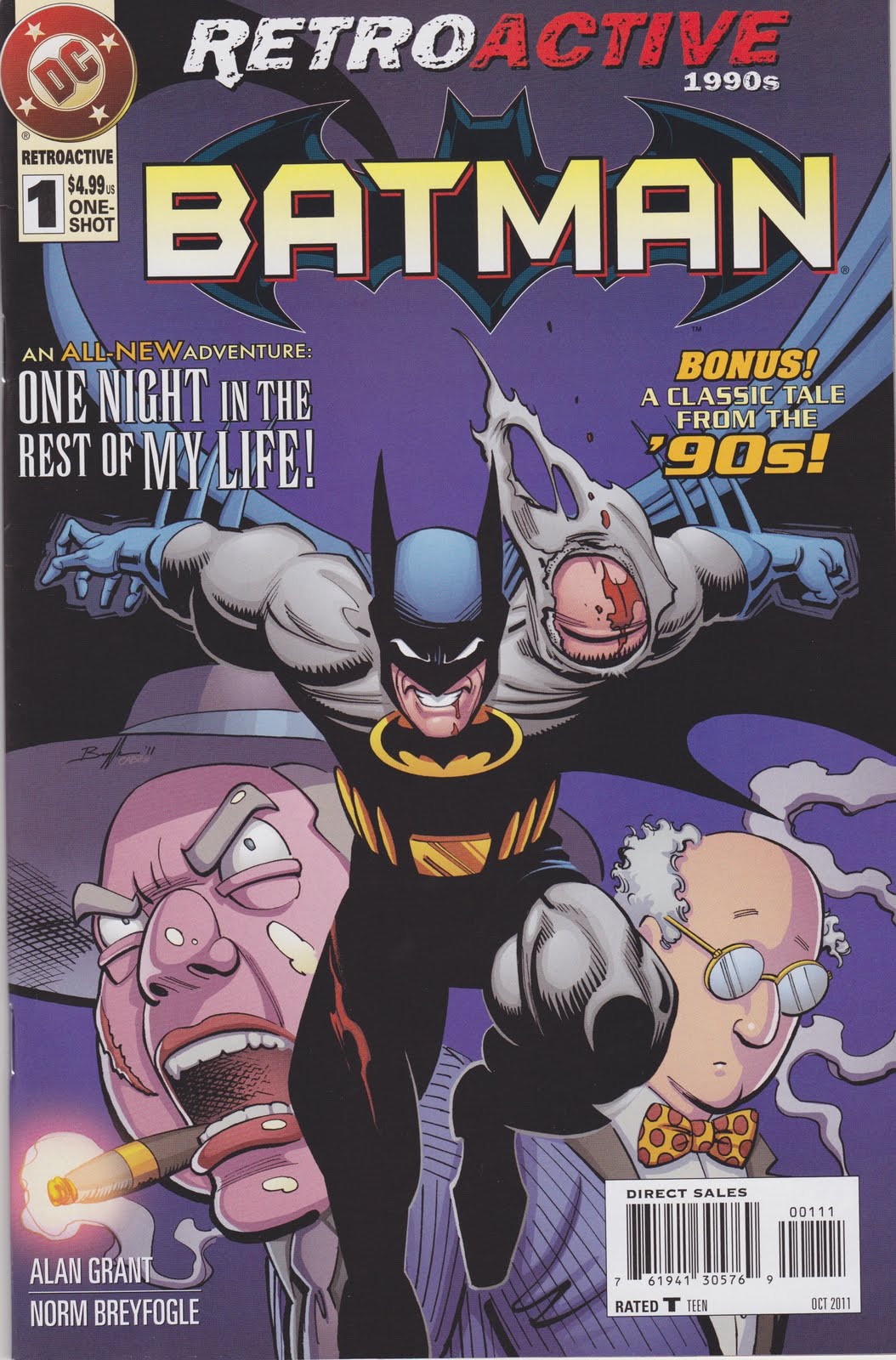
When the DC Retroactive comics were announced, I was pretty excited. It sure did sound like a great idea to reunite creators to tell “one last story” within the framework they provided for a given era. Then they started rolling out at $5 a pop. It’s certainly a reasonable price, since each of these books is both a new 20 plus page story with a bonus reprint from the creators’ original run. I thought I would be grabbing some of the 70s and 80s era comics, but I wound up having a hard time justifying spending the $5 to get a new story and a reprint of something I already had kicking around in the collection.   So I thought the only one I would wind up with was the 90s Batman, which I had been very eagerly awaiting, given my love for Grant and Breyfogle Batman stories. 

But I wound up with four of the 90s books and I really enjoyed them! Full disclosure: I loved these comics because they brought back a little smidgen of what comics were like when I first started reading them. DC had a great idea here.

Without further ado...

DC Retroactive: Batman 1990s


So as I mentioned, this was the one book I was really looking forward to out of the bunch. It’s kind of funny that Alan Grant’s story almost crammed too much into the twenty some-odd pages. Overall, I don’t think we were treated to Grant’s best work here. There was some painful dialogue and heavyhanded narration. But you know what? I didn’t even really care. Norm Breyfogle was awesome as he always is. He got to do a lot of his signature Bat details here, from the cape to the nightvision eyes to Batman’s acrobatic kick from the ceiling. I really hope that DC would be able to convince these two guys for a miniseries, like they recently got one of the 90s’ other most celebrated Bat teams to do (Doug Moench and Kelly Jones). 


The reprint: Detective Comics #613, 1990. It’s an issue called “Trash.” It’s a stronger effort from the writer, and while Breyfogle is still great here, we can see how much he has improved with time. This story plus the new one? Easily worth the $5.

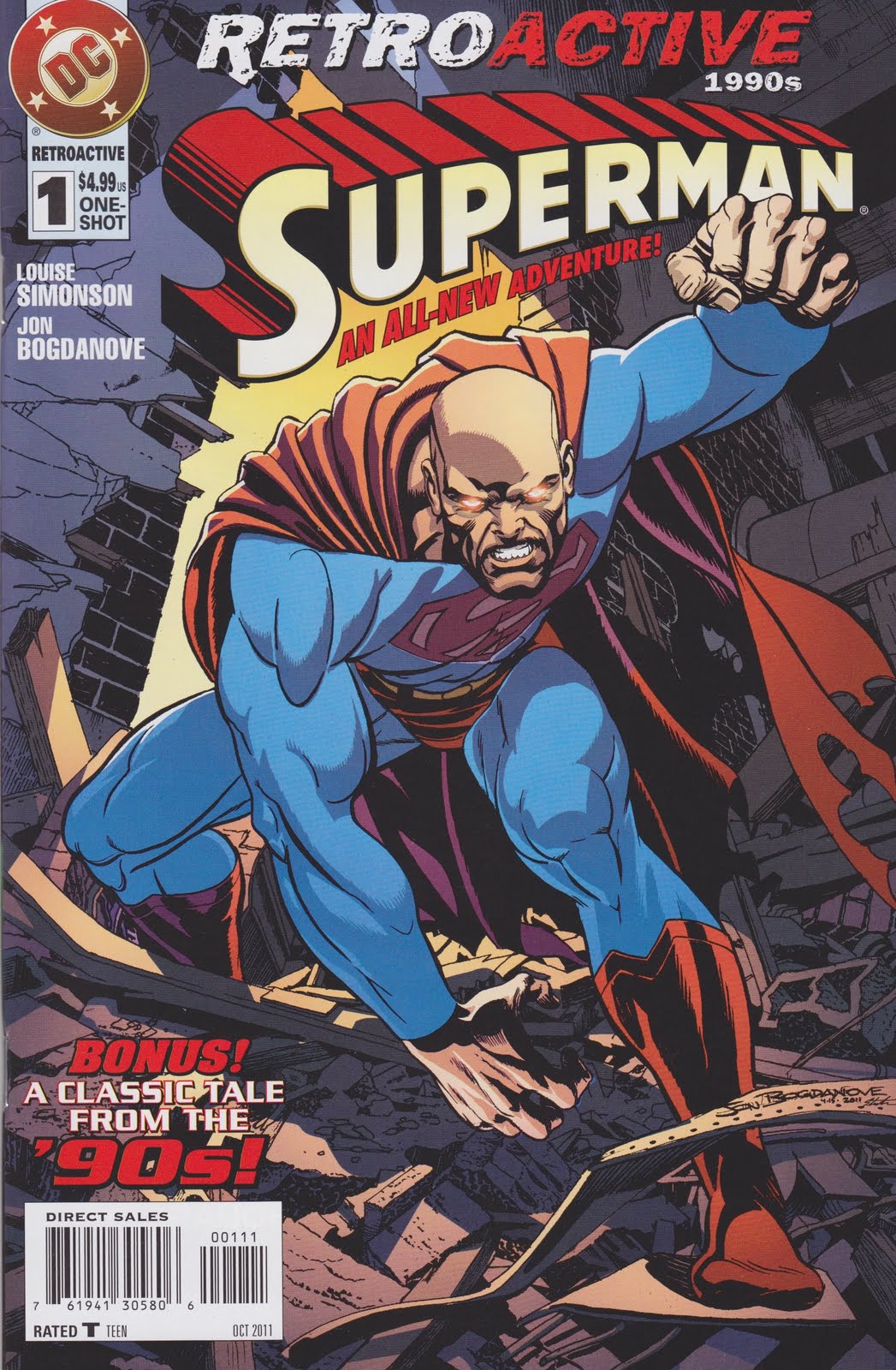
DC Retroactive: Superman 1990s


I mentioned that the story seemed just slightly off in the Batman comic. Well, this one felt completely ripped out of the early 90s run by Louise Simonson and John Bogdanove! It kind of made me wonder if it was really a lost script. Superman has the mullet, the cloned Lex Luthor is pissed off, everyone is talking about Doomsday, yep, everything is perfect here. The story features the return of Cruiser, a big bad monster who can burrow through anything. It causes a lot of destruction throughout Metropolis and even burns Supes’ hair off (though strangely, not his costume).


The reprint: Superman: The Man of Steel #12, 1992. Here’s another reason why this Superman Retroactive was so successful in my eyes. The reprint perfectly dovetailed with the new story. In this older story we see a previous appearance of Cruiser. It might be beneficial to read this story and then move onto the next one.

DC Retoractive: Green Lantern 1990s


Ah, Kyle Rayner. You were the first Green Lantern I knew about when I started reading comics. I know a lot of people didn’t like you. But I always thought your costume was really cool and I liked that you were “the Last Green Lantern.” Now everything has been retconned. Hal is back, the Corps is back, and though you still exist, you’re nothing compared to what you used to be. That makes me kind of sad. But hey, DC got Ron Marz and Darryl Banks back together to tell one more story!

Simple story here: Kyle is on guard duty at the JLA satellite and Effigy shows up to wreak havoc. So this comic really gets you right back into all of the details, such as Kyle’s always entertaining narration, his inventions with the ring, and Effigy’s never ending rage. Once again, this could have been a “lost issue” of the original Marz run. 


Reprint: Green Lantern #78, 1996. This was a nice “who I am” issue. This is why I was lamenting the fact that Kyle isn’t very important anymore. He was such a well fleshed out character, and because of the strange cyclical nature of comics he’s now been pushed out of the way for Hal Jordan to come back. It’s just a shame. Maybe DC can start a good trade paperback run of the 90s Green Lantern now? I really hope that sales of these Retroactive books are able to get DC thinking about more collections to put out.  How long have people been clamoring for Grant and Breyfogle Batman trades?

DC Retroactive: Justice League America 1990s.


“Together again for the last time (we hope!)--Keith Giffen, J.M. DeMatteis, Kevin Maguire.”
That should pretty much be enough said on the subject. The Justice League comics these guys put out were so, so good. It was pretty daring, doing what they did. Taking the biggest team of costumed heroes on the planet and turning their story into a humor book and a soap opera while keeping just enough of the classic superhero action. 

This might have been the best of the Retroactive books that I read. It’s just hard to beat the great scripts that Giffen and DeMatteis put together, where everything is so witty and carefully orchestrated. And then there is Kevin Maguire, who is really one of the most talented people who has ever drawn comics. Nobody can beat him on making these characters seem real.

The story: the Injustice Gang is up to no good, as usual. A Godzilla-sized parademon destroys a lot of stuff, and everything is cleaned up by the end. Again, pretty simple, but just enough to make everyone happy and remember a bygone era of Justice League history. Great comic.


The reprint: Justice League of America #6, 1992. When I started reading this, I hadn’t realized its significance as the last comic the three guys made before moving on to other projects. That gave it some context for me. It’s an issue that is really just catching up with all of the characters. Although I haven’t read probably half of the stories they did together, I imagine this comic was a nice bow tie to the Giffen/DeMatteis/Maguire days.

So overall, I am so glad that DC put together this line of books. Who knows, maybe now I will track down some of the 80s and 70s Retroactives as well. I’ve already found the ones that mean the most to me though. As DC gets ready to move into a brand new era this week, it was really nice to see them spending time looking back on the past. Thanks for the memories...

Thursday, August 25, 2011

Northlanders: Metal and Other Stories


Ah, Northlanders. How glad I am that you exist.

I think it’s safe to say that Northlanders is, by this point, the longest-running Viking comic ever. Brian Wood has made it an exciting read every time I pick up the latest trade. There isn’t an ongoing narrative in this comic; the focus shifts with each storyline. The longest story in this collection, Metal, involves a very strong blacksmith wreaking havoc on the Christians who have taken over. The Christians aren’t stupid though. They hire a big strong native of their own to oppose him. This is a story about new religion versus old religion and greed versus preservation. Riccardo Burchielli has a versatile style in his artwork. He draws gory battle scenes, mushroom-induced hallucinations, and even some really nice quiet scenes in these five comics.


Backing up, “The Sea Road” is the story that leads off this collection. It’s the tale of a particularly perilous journey of a few men at sea. Men who are greedy and will do virtually anything if it means a little more loot in their pockets. The boat winds up touching shore somewhere in America. Only one viking remains alive after he kills the last of his companions, and when he sees the natives, he has a rather important sounding speech:

“You should kill me. I deserve it, bringing this butchery to your fine beach, here. But if I could leave you lads with one bit of advice? More of a friendly warning, really. I couldn’t tell you when, but I can say for a certainty there’ll be more men just like me who’ll find their way here. Like I said, too beautiful a place.”

The natives quickly slay the invader, but everyone reading knows that it’s only a matter of time before the fortunes are reversed.

“The Girl In The Ice” closes the collection. It’s a story illustrated by Brian Wood’s frequent collaborator, Becky Cloonan. An old man is ice fishing when he notices something very strange: a young woman’s body has risen to the top of the ice. The old man wants to solve the mystery of who this girl is, but risks the authorities finding out that he is holding a corpse in his home. He could be accused of any number of crimes for something like that, but he truly only wants to get to the bottom of the problem. Things don’t end well for him, but the mother of the girl at least gets to know the truth of what was going on.


So that’s a little taste of what Northlanders is all about. It’s a series that I love picking up because the story is always going to be something different. Brian Wood has done an awesome job. I remember listening to a podcast interview with him some years ago, probably when Northlanders was in its first year. He was saying that he was concerned mainly with telling good stories about these people. Maybe some things in the timeline aren’t all too accurate. He also made a stylistic choice that is sure to irk some people: the characters in Northlanders speak in a modern dialect rather than anything archaic and Norse-like. I personally view it as a positive. If you want to read Thor-speak, well, thank god we have Thor as a book to read too.

Thursday, August 11, 2011

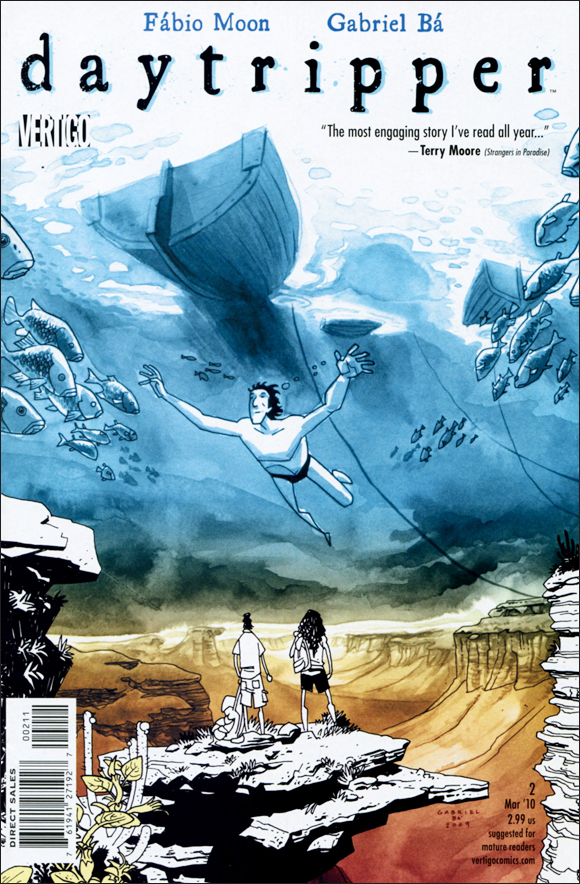
Daytripper


As if Vertigo comics weren’t already diverse enough, Brazilian brothers Fábio Moon and Gabriel Bá bring another distinct kind of comic to the imprint’s lineup. Daytripper reads like something you would find from one of the industry’s smaller companies. It is a powerful set of stories asking the question “What are the most important days of your life?” The structure of these comics at all times emphasizes that question as it follows the life of one man.

Brás de Oliva Domingos is a man who in some chapters seems rather ordinary. In other chapters he is more like a celebrity. He always has his doubts, he always has his faults. In Daytripper we get glimpses into his life unlike any others; we see him live more and die more than any normal person. 

Dave Stewart lent his coloring skills to Daytripper.

Yes, this was the structural idea that the brothers had when they decided how to craft their story. There are ten comics collected in Daytripper, and each one focuses on Brás when he is at a certain age. The only thing that is certain in each comic is that Brás will die by the last page. Maybe some people will get bent out of shape about this “non-temporal” kind of comic. But then they would be missing the point. 

Daytripper is crafted to make the reader remember the most powerful moments in his or her own life. So the many deaths of Brás show how mortality is always just a moment away at any point in time for any person. There are so many unfortunate things that can happen in life, but Moon and Bá made this story to emphasize all of the good and happy things that can happen too. The result is a comic that feels so real, in a way that stories can’t often accomplish.

Brás de Oliva Domingos wants to be a writer like his father. So far his writing career has amounted to him writing obituaries for a local newspaper. This is the status quo in which many of the stories begin. Other stories show him before he found the job, and some stories even show him as a successful novelist who followed in the footsteps of his father. Brás makes his way through the stories that are marked by his corresponding age in each chapter.

May I point out a few of my favorites?

How about “28.” Brás is in a time of upheaval and uncertainty. His longtime girlfriend has had enough. Her boxes are packed and she’s moving out. One angry tirade, some mean words, and a slammed door and Brás is on his own again. Now maybe her frustration wasn’t completely unjustified. Maybe Brás wasn’t very good to her. But he knows now that his life needs to change, but he is a little worried about how he’s going to do it. He talks to his father, a novelist who is full of insight into the human condition. He advises Brás to look for the moments that give life meaning. It doesn’t seem to be the message that Brás wants to be hearing right then and there. 


But then he finds his way to a bakery...and he sees the woman that he knows he will spend the rest of his life with. It’s obvious to him. He watches her from across the store and doesn’t even notice when his purchase is rung up. Brás is too smitten to talk in the store, but then he realizes that he has to talk to her. He goes running into the street, too excited to pay attention, and gets hit by a car.

Maybe the chapter that most clearly emphasized the duality of life and death would be “41.” This comic starts out looking like it’s going to be the most joyous of all of them all. Ana, Brás’ wife, is about to have their child. They head to the hospital, nervous and yet excited. Then Brás knows that something is wrong. At the same time that he is awaiting the arrival of his firstborn son, his mother is at the hospital for an altogether different reason. Brás’ father has just died. So Brás has to deal with the feelings of extreme joy and extreme sadness all at the same exact time. He has to hide his pain from his wife until she is well enough to bear the news. And it is far from easy for him.

The saddest and most haunting chapter would have to be “47.” Brás himself is never really seen in this one, because he is away on a book tour. Ana is having a difficult time in the temporary role of a single mother for Miguel, who is now old enough to go to school. Brás is always calling, sending texts, and writing emails for Ana to find. He’s doing all that he can to make sure that Ana is alright while he has to be away and living the life of a successful novelist. He doesn’t ever come back as his life is taken unexpectedly by tumors in his brain, dying in an emergency room surgery. Ana and Miguel know that life is going to be difficult and that things are going to be sad for a very long time, but that they have the strength to move forward.


Gabriel Bá and Fábio Moon have deservedly won a lot of awards for their work on Daytripper. They created meaningful characters and down-to-earth situations that I sincerely hope everyone could identify with in some way. It’s a beautiful story with a lot of depth that really forces you to realize what is important in life. Everything can change so fast...

Wednesday, August 10, 2011

Hellblazer: City Of Demons


This is the first post in a series that will amount to a lot of gushing about how great Vertigo comics are. I must have already said by now how I think it’s one of the most important little branches in the comics publishing industry. They tell all kinds of stories, sometimes even the stories that anyone else would be afraid to publish.

So here’s part one of four in “Thoughts About Vertigo in August.” Hellblazer: City of Demons is a great place to start, since John Constantine’s adventures have been the one constant running throughout the entire history of Vertigo since it was officially started in 1993. It’s curious to me that this story was published as a separate miniseries rather than as part of the nearly 300 issue long saga that has been running since the 80s. I guess it’s nothing to complain about...extra Constantine is a very good thing.


City of Demons is a really top-notch Hellblazer comic. I had never heard of Si Spencer, the writer. He did a Vertigo series called The Vinyl Underground a few years ago which was completely under my radar. And apparently in the 90s, being a good British comic book writer, he lent a hand in telling some Judge Dredd stories. So it’s always a little strange wandering into the writings of someone you’ve never before encountered, but Spencer proved himself to me.

Moving onto the art, Sean Murphy really made City of Demons into an incredible comic. I can now say that I believe the hype that this guy generates. The only book I ever read by him before this was a Batman/Scarecrow Year One story that was put out in 2005 to sort of tie in with Batman Begins. Looking between the pages of that comic and City of Demons was amazing. He’s come a long and way and has certainly deserved all of the praise that he is getting. Everything is very stylized and powerful.

Let’s not forget to mention that Dave Stewart is the colorist. As usual, he has developed a unique coloring style for yet another project. Here’s another guy who is much lauded, and deservedly so. He does so much for all of the comics he contributes to.


John Constantine gets hit by an SUV in the first few pages of City of Demons. This results in him being carted to a hospital for brain surgery while his disembodied spirit wanders around the hospital. What he doesn’t realize right away is that some of his blood is taken to be used for other patients, and this is some very, very bad news. Constantine kind of sort of has a lot of demon blood in him after a certain transfusion he took from Nergal some years back. So if a pint of his blood was used for plasma and distributed to a bunch of people who needed it at the hospital, well...there’s going to be trouble. Hence the title City of Demons. 

There are several people who start acting crazy and bloodthirsty and downright demonic. And it’s all because Constantine went to the hospital. Sure enough, the Hellblazer gets to the bottom of it all and the evil doctors who are all too aware of what they are doing are cast into the gaping maw of the infernal regions. But even when he thinks he’s safe again he is dead wrong.


John Constantine is a character whom a lot of people have grown attached to over the years. He isn’t a pleasant type of person, and in fact he’s usually being a cranky asshole. Si Spencer had the characterization down perfectly, which was great to see from someone who was new to the character. His story was fast paced and always exciting, and yes, frequently gory. Murphy in turn was only too happy to indulge in Spencer’s scripts, bringing everything into perfect detail. 

This was really an A+ Hellblazer story. If you’ve been too afraid to jump into the collections of the regular series, check this out. All of the Constantine books are fairly self-contained, but this is a book that seems especially designed for someone who doesn’t know a thing about the character and wants to dive in headfirst. 


As a bonus, the end of this book features a prose story by Dave Gibbons which he also provided spot illustrations for.


Wednesday, July 20, 2011

Batman: Holy Terror


Here's the second installment of my "DC Elseworlds" series of posts: it's a short review for a short book.

It was a good idea to get Alan Grant and Norm Breyfogle to do something for the Elseworlds imprint, or really to kick it off, since this was the first comic to be published bearing the Elseworlds logo. They were pretty popular as a Bat-team back in the day. They took full advantage of the Elseworlds framework and clearly took a wild idea and ran with it. In Holy Terror the modern world is a very different place because Oliver Cromwell didn't die (excuse my shoddy observance of the history of England) when he did in reality but lived on to see old age. The resulting change in history is that theocracy spread throughout the world, even to Gotham City. 

Bruce Wayne is on track to becoming an ordained minister, but then he finds out the truth behind the deaths of his parents: they were not simply gunned down as he was led to believe. Rather, they were executed by the state for giving medical attention and support to social deviants who sought "counter-reproductive" lifestyles. Bruce wants revenge on the society that would allow for such discrimination.

So it isn't explicitly said, but this is a story of ideologies: religious conservatism vs. all that is deemed "immoral" by the same theocratic Bible-beating leaders. Batman is a force of chaos against the order imposed by the church-run state. He finds that fighting an ideology is not nearly as simple as fighting a person or even a group of people. He resolves to fight even though he knows it will be far from easy.

I definitely understood why this graphic novel is generally held in high esteem. There's a lot to think about with this story, and the Grant/ Breyfogle team is really at the top of their game here. For added fun, there are plenty of DC characters who make appearances throughout the 48 pages. Society's "freaks" are not looked upon favorably in a world that favors conformity.  There's a strange sort of Justice League that forms in Holy Terror.

Any complaints? Well, this story could have really filled so much more than just a thin 48 pages. There are some later Elseworlds projects that are pretty lengthy, and this one, the first one, really tries to cram too much into too little. So I guess we can all be glad that Holy Terror was both good and successful because it allowed other projects of more ambitious lengths to be created. I'm sure that by the time you get to the end you'll be saying "Hey, I want to read more about this Batman who roams around Gotham wearing a priest collar!" 

Saturday, July 9, 2011

Justice League: The Nail

I’d like to do a series of posts on DC’s Elseworlds imprint, which sadly has been a thing of the past for some time now. It was a great excuse to just make some fun comics. Top-tier writers and artists set loose with the DC characters and given free rein to put them into whatever kind of new settings they wanted? Sign me up.

The Elseworlds title discussed here came out in 1998, right when I started ravenously collecting X-Men titles. Justice League comics were outside of my radar at that point. The connection here is that after wrapping up this Justice League work, Alan Davis (the double-duty writer and artist on The Nail) took over the writing of the X-Men comics and drew X-Men on a monthly basis. Back then I honestly didn’t like Davis’ style, much preferring the work of Adam Kubert on Uncanny, but wow, with time did my opinion of Davis change. I really love his work now, and I made it a priority to seek out some more of it...the first thing I found was Justice League: The Nail.

In this story, the Justice League exists and looks much the same as it did in, I would say, the post-Crisis DC Comics of the late 80’s. But the Elseworlds spin is that this is a world without Superman. The story is titled after a nail that pops a tire on Jonathan Kent’s truck as that little space pod crashes in a field near Smallville. We’re led to believe that this is the trip that would take the Kents to find a baby Kal-El, but because of the change of one small part of the plot, this never happens.

The Justice League is feared. There’s an anti-metahuman agenda that is largely spread by Lex Luthor, the mayor of Metropolis (he’s still the super-smart rich guy in this version too). The media always seems to be there to capture the perfect shot of a bad guy getting beaten to a pulp. Batman is caught in the act of killing the Joker, which sure does sound like some harsh justice. What the cameras and microphones don’t catch is that the Joker just killed Batgirl and Robin after wreaking havoc throughout Arkham Asylum with some mysterious Kryptonian technology.

It just wouldn’t be nice to give away too much of the story here. Alan Davis definitely packs in a lot of plot in these 150 or so pages, which were originally published as three prestige format comics and later collected into trade paperback. Pretty much any DC character you can think of is at least seen in this book in a panel or two. That’s some Crisis-like ambition on Mr. Davis’ part! I definitely enjoyed The Nail, but I felt that the whole thing was wrapped up far too quickly. This could have used a “Chapter Four of Three” for sure. The reveals and the twists come pretty quickly in the last 25 pages. Minor spoilers: we knew from page one that Kal-El did land on earth, so it shouldn’t be too surprising that he eventually shows up. It just would have been nice to see him do a little bit more, but as the final pages mention, this isn’t the end of a story but the beginning of a new one. You can bet that I’ll be on the lookout for Justice League: Another Nail, the 2004 sequel Davis worked on, soon.

In what might become a regular new feature of these reviews, I have some little snippet observations:

I really loved the way that Davis drew the Flash. He was still muscular but kind of skinny. It makes sense that Barry Allen wouldn’t be quite as ripped as most of the other superheroes.

In the “slight disappointment” department, the New Gods characters are all shown and a war starts up, presumably related to all the goings-on back on earth. But after starting, the rest of this conflict isn’t shown. I figured there would be a New Gods/ earth smashup of sorts (I expected Darkseid to be behind some of it) but it all proved to be an afterthought. I guess I would have liked to help Alan Davis out with the plot for this thing, just a little. By cutting out those essentially space-wasting New Gods scenes he could have dedicated a few more pages to padding out the ending better.

Another thing that I think is a bit of an Alan Davis trademark is that sometimes when a character is wearing a mask with the “white eyes” he draws the pupils so you can get a better sense of the character’s emotion. I know that other artists do this too, but for some reason I always get slightly distracted when Davis does it.

Let’s have a round of applause for Mark Farmer, the inker on this fine publication. He’s Davis’ right hand man, and this is a very good thing.

This was a wonderful plot-based superhero story. Look elsewhere if you want to really dive into characterization. A lot of what draws you into the superheroes in this story is what they do. Martian Manhunter is seen doing his “watching TV” routine. Davis painstakingly shows how the Atom gets into a villain’s laboratory. The Nail is an action story told on a grand scale.

If you happen to come across this book in trade paperback format and are slightly interested in, you might as well just snag it. The Nail is an older DC trade and isn’t in print currently. In summary, you really can’t go wrong with the artwork of Alan Davis, and his storytelling, while overly grandiose, is still engaging.


Monday, April 18, 2011

iZombie: Dead to the World


iZombie has art by Michael Allred.  Read it.


//////////////////////////////////////////////////////

…well, if you ask me, that should be more than a good enough reason to get into this book. But maybe not everyone is a complete dork for “Doc” Allred. Maybe some people don’t care about Madman at all, or maybe X-Force (and later, X-Statix) didn’t really strike them. The issue of Sandman with Prez in it, the Atomics, the Wednesday Comics Metamorpho series. 

Oops. Just had a big old tangent. This tends to happen when I start talking about Mike.

I was sad to find out that Allred was going to be shutting the door on Madman Atomic Comics, probably because it seemed like such a great experimental series that simply didn’t last long enough. The initial news that he would be working with Vertigo was great, then the title iZombie was a little bit of a groan (even Apple needs to stop with the iEverything), and then the news that Mike was going to be working with this writer whom I had never heard of…oh my.

Chris Roberson is this writer’s name. And after reading the first six issues of iZombie, I was really, really stupid to be afraid of liking this book. The Roberson/Allred team is doing some great work here!

Gwen Dylan is a gravedigger. Not a profession you might expect for a cute looking pinkish/purplish-skinned woman. She works with the guys but they don’t really know the truth about her. Just that little secret about how she is a zombie and has to eat a human brain once a month.

Eating a brain probably isn’t what you would expect. It’s not like normal food. When Gwen gets a taste of someone else’s grey matter, she also gets a flood of that person’s memory.

Without giving away hardly anything of the plot of iZombie, how can I make it sound like a lot of fun? How about the characters. There are a lot of them introduced in this book and every one of them is pretty interesting. Gwen’s best friend is a teenage ghost girl who’s been dead since the 60’s named Ellie. Then there’s Scott, the first Were-Terrier I’ve ever read about (ooo scary). There are sexy vampire women who are out to prey on the weakest of men. There’s Horatio and Diogenes, two guys with impossible names who also do impossible work for the Fossor Corporation, hunting all kinds of monsters just like their predecessors have for millennia. There’s John Amon, a maybe-mummy who tells Gwen the many secrets of the supernatural that she never would have found out on her own.

This is a book that is full of the kinds of quirks that come standard with any comic that Mike Allred’s name is attached to, but obviously a lot of the quirk is coming from the mind of Roberson too. One favorite thing is how Dixie, the waitress at Gwen, Scott, and Ellie’s hangout diner, never questions how her customers are pale to the point of transparency, or pinkish/purplish in skin tone, or happen to have hoodies wrapped tightly around their heads so that nobody can tell that they really have the facial structure and hair of a Scottish terrier.

One smart, smart thing that I bet a lot of writers would smack themselves over the head over (asking “why the hell couldn’t I have come up with that?”) is the classification that Roberson devised for all of the various kinds of spooky creatures that exist. As Amon describes, there is a whole system that can perfectly describe how someone can be either a ghost or a poltergeist, or a vampire or a zombie and so forth. There’s this concept of the oversoul and the undersoul, and what happens after death with each can lead to some interesting afterlives…

There's a lot going on with all of those vampires, zombies, and werewolves.

A couple of other good reasons to love iZombie: the other two members of the book’s creative team, the ones who might be a little bit out of the spotlight but nevertheless make this a comic that is oh-so-slick. The colorist is Mike’s wife Laura (as is true for any project Doc works on). Laura makes pages look beautiful. She’s definitely a huge bonus to the quality of anything that Mike draws. And the letterer, who is probably always the least-sung member on the bandwagon, is the legendary Todd Klein. It’s always just comforting to have a comic in your hands in which the which the words have been transferred from script to page by the guy who did things like Sandman and Promethea.

It’s just one nice looking comic from start to finish.

Maybe now that you’ve made it this far it’s safe for me to identify myself as an enthusiastic advocate of Vertigo comics. This is related to some of the comments I made in the post about the Eisners: Vertigo does comics that are different. Comics that stand out and do things that other comics don’t. While most of the readers of comics are adults, Vertigo is a company that makes things for adults to actually read. It’s a great imprint and I’m always looking to see what comes out of their offices next.

Anyway, iZombie. Nothing else will do to bring this post to a grinding halt, so it’s time for a Captain Picard quote: “Make it so!”