
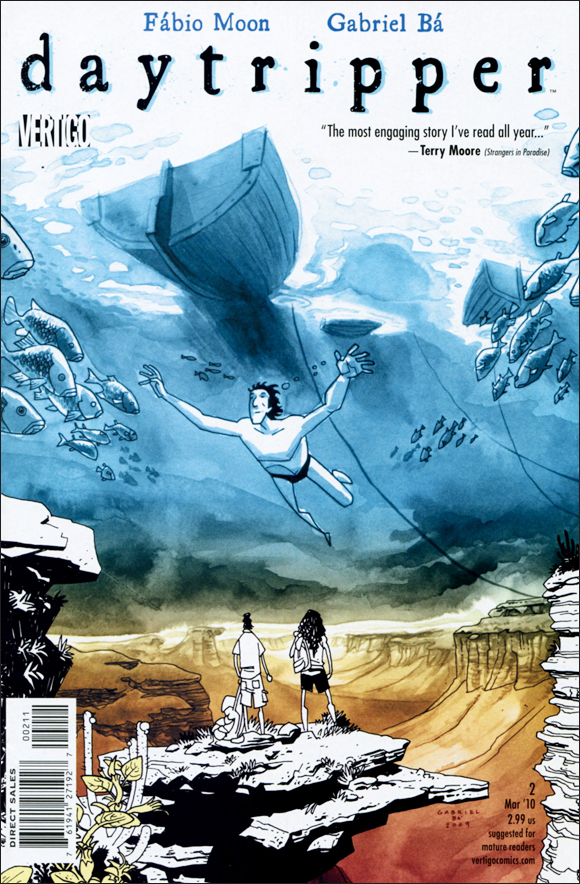
As if Vertigo comics weren’t already diverse enough, Brazilian brothers Fábio Moon and Gabriel Bá bring another distinct kind of comic to the imprint’s lineup. Daytripper reads like something you would find from one of the industry’s smaller companies. It is a powerful set of stories asking the question “What are the most important days of your life?” The structure of these comics at all times emphasizes that question as it follows the life of one man.
Brás de Oliva Domingos is a man who in some chapters seems rather ordinary. In other chapters he is more like a celebrity. He always has his doubts, he always has his faults. In Daytripper we get glimpses into his life unlike any others; we see him live more and die more than any normal person.
 |
| Dave Stewart lent his coloring skills to Daytripper. |
Yes, this was the structural idea that the brothers had when they decided how to craft their story. There are ten comics collected in Daytripper, and each one focuses on Brás when he is at a certain age. The only thing that is certain in each comic is that Brás will die by the last page. Maybe some people will get bent out of shape about this “non-temporal” kind of comic. But then they would be missing the point.
Daytripper is crafted to make the reader remember the most powerful moments in his or her own life. So the many deaths of Brás show how mortality is always just a moment away at any point in time for any person. There are so many unfortunate things that can happen in life, but Moon and Bá made this story to emphasize all of the good and happy things that can happen too. The result is a comic that feels so real, in a way that stories can’t often accomplish.
Brás de Oliva Domingos wants to be a writer like his father. So far his writing career has amounted to him writing obituaries for a local newspaper. This is the status quo in which many of the stories begin. Other stories show him before he found the job, and some stories even show him as a successful novelist who followed in the footsteps of his father. Brás makes his way through the stories that are marked by his corresponding age in each chapter.
May I point out a few of my favorites?
How about “28.” Brás is in a time of upheaval and uncertainty. His longtime girlfriend has had enough. Her boxes are packed and she’s moving out. One angry tirade, some mean words, and a slammed door and Brás is on his own again. Now maybe her frustration wasn’t completely unjustified. Maybe Brás wasn’t very good to her. But he knows now that his life needs to change, but he is a little worried about how he’s going to do it. He talks to his father, a novelist who is full of insight into the human condition. He advises Brás to look for the moments that give life meaning. It doesn’t seem to be the message that Brás wants to be hearing right then and there.

But then he finds his way to a bakery...and he sees the woman that he knows he will spend the rest of his life with. It’s obvious to him. He watches her from across the store and doesn’t even notice when his purchase is rung up. Brás is too smitten to talk in the store, but then he realizes that he has to talk to her. He goes running into the street, too excited to pay attention, and gets hit by a car.
Maybe the chapter that most clearly emphasized the duality of life and death would be “41.” This comic starts out looking like it’s going to be the most joyous of all of them all. Ana, Brás’ wife, is about to have their child. They head to the hospital, nervous and yet excited. Then Brás knows that something is wrong. At the same time that he is awaiting the arrival of his firstborn son, his mother is at the hospital for an altogether different reason. Brás’ father has just died. So Brás has to deal with the feelings of extreme joy and extreme sadness all at the same exact time. He has to hide his pain from his wife until she is well enough to bear the news. And it is far from easy for him.
The saddest and most haunting chapter would have to be “47.” Brás himself is never really seen in this one, because he is away on a book tour. Ana is having a difficult time in the temporary role of a single mother for Miguel, who is now old enough to go to school. Brás is always calling, sending texts, and writing emails for Ana to find. He’s doing all that he can to make sure that Ana is alright while he has to be away and living the life of a successful novelist. He doesn’t ever come back as his life is taken unexpectedly by tumors in his brain, dying in an emergency room surgery. Ana and Miguel know that life is going to be difficult and that things are going to be sad for a very long time, but that they have the strength to move forward.

Gabriel Bá and Fábio Moon have deservedly won a lot of awards for their work on Daytripper. They created meaningful characters and down-to-earth situations that I sincerely hope everyone could identify with in some way. It’s a beautiful story with a lot of depth that really forces you to realize what is important in life. Everything can change so fast...


