Pages

Friday, August 5, 2011

Hero Comics 2011


Let me begin by mentioning how glad I am that Hero Comics exists. This comic could be filled with absolute trash (which is completely not the case here) and it would still be worth every penny. I can say this because it's being put out to as a fundraiser for the Hero Initiative, which is a really great charity that benefits comics creators young and old who might need financial assistance with medical or other expenses. The people behind HI are doing some good work.

Last year was the initial issue of Hero Comics, and somehow I missed out on it. I was sure to snatch this year's edition, which has some important names on the credit list...what else have Neil Gaiman, Sam Kieth, and Mike Dringenberg worked on together besides the nine page story included here? Oh yeah, just the first few issues of that little comic called Sandman. And here we are, more than two decades later, and the band has been put back together for one night only to raise money for charity.

There are 31 pages of comics in this book, which is more than what you usually get in a floppy. Like I said before, it's worth every penny, but honestly...the Sandman team reunion wasn't the highlight of the anthology for me. The story, "My Last Landlady," is something I wouldn't hesitiate to call "abstract," "impressionistic," and even "obtuse." I appreciate the guys doing some new work for a good cause, but I wasn't quite entertained by the end results.

My favorite part of Hero Comics was definitely the Chew story. This was just a great idea...get the creators of one of the hottest indie titles today to make a funny little five page story. Tony Chu has to ingest some designer drug this time, all in order to help the police find out where it's from and who made it. He has a bad trip.

The third story is my biggest problem with Hero Comics 2011. "Once Upon A Time" is a story by Sam Kieth that runs for nine pages. It is about how "My last Landlady" came to be, and that was a nine page story itself. So in reading this there was a little bit of insight into the making of a comic, but it definitely ran too long. I wish the nine pages could have been devoted to, well, a whole host of other things. Two more short stories. Nine pinups. This just felt like it was space that could have been used so much better.

The last story was an Elephantmen tale written by Richard Starkings. I've always been intrigued by the comic but have never read it. I'm a little more interested in the series after reading this, so thank you Mr. Starkings!

I almost forgot to mention that there are a few one pagers that illustrate exactly how the Hero Initiative has had an impact on specific comic creators. They were good reminders of why this comic, and the charity as a whole, exist in the first place.

So please look for Hero Comics 2011 and visit the Initiative's site to learn more about an important organization that is always ready to help comics creators who are in need.

Wednesday, August 3, 2011

Doctor Who: Final Sacrifice


Back when I started this blog a few months ago, I teased a few books that I had recently read. I might have promised to review them, and I know with certainty that I didn't review them. One of the books that I never got around to was Doctor Who Volume Two: Tesseract, the volume preceding this one. We can be thankful that by this point in time I feel like I'm getting the hang of things...months go by, tons of comics come out, ta da! I have some things to say about Volume Three at least.
Let me start off by saying that I really admire what Tony Lee was able to accomplish with this ongoing Doctor Who series. Well, at sixteen issues it might not have been a very long running series, but it was a quality story. Before IDW greenlighted this series they had been doing a bunch of one shots and miniseries. There were definitely some good stories from that era, but doing the ongoing was an even better idea. What Lee got to do here was make a long running story and set up a bunch of comics that just felt exactly like watching a season of the tv show unfold. Maybe it was just a more comfortable approach to the Doctor.

Tony Lee made his own storyline and supplied his own companions, so it wasn't like the comics were meticulously sandwiched in between plotlines during the seasons of the Tenth Doctor. He gave the series its own breathing space and it was great to watch it all develop.
I had a thought about Doctor Who comics that would be really neat. I'm sure it will never happen, because it would need the BBC to try something pretty risky with one of their perrenial cash crops. But wouldn't it be neat if you could get a comic-exclusive version of the Doctor? "Doctor Who comics from IDW...the only place you can experience the adventures of the Twelfth Doctor!" Just so that you would never have to worry about how it all fits together. But maybe that would be missing the point altogether...would people care about a Doctor they had never watched on television? I'm not sure.

So this final trade paperback collection is entitled Final Sacrifice. The sacrifices are, as is often par for the course in a Who story, the companions. I liked them. Emily Winter and Matthew Finnegan. The Doctor found them in the early days of Hollywood back in volume one. The Advocate's big scary plan nearly comes to fruition and the mysterious Tef'Aree finally gets a little less mysterious. Fifth dimensional beings are a little bit difficult to wrap your head around.

The story ends with the Doctor heading to Mars, which means that all of this adventuring directly precedes one of the specials they did before David Tennant left the show. So they did please the fanboys who wanted to know how all of the puzzle pieces fit together after all.
Matthew Dow Smith is a terrific artist. I feel like I've seen a lot of people who draw somewhat similarly to him, and he is certainly doesn't hide a Mike Mignola discipleship. Despite that, he still seemed pretty original to me. I liked how there wasn't the creepy factor that often comes with comics adapted from film where you can tell what frame the artist paused on to get the perfect facial expression. I like the stylization. 
The grand conclusion to the "Tony Lee season" isn't the only reason to look into this collection. It also reprints the Doctor Who Annual, which was quite a treat because it features three stories that are all centered around the TARDIS. The first one is entertaining although it feels like it strays a little too far from what is acceptable as a DW story. An alien goes pretty far to try and sap the energy from his trusty ship, masking himself in the guise of a human traffic control officer. Just slightly more odd than what you see in a typical Who tale. Al Davison returns to close out the TARDIS book, and his style was wonderful in the earlier issues of the Tony Lee series for reasons altogether different from why Smith shines. Davison has the kind of detailed style that allows him to pull off the likenesses of actors, and he does so very naturally. I do wish that he could have been involved with a few more issues.
Here's an example of why I was a fan of Al Davison's work on the series (from his TARDIS story reprinted in this book).
So this is the final collection of IDW comics featuring the Tenth Doctor, and of course they plugged right along and started a new series in the Matt Smith era. There's already a trade out that I'm late in reviewing...

Monday, August 1, 2011

Avengers Volume One


A new team slapped together just before a major crisis comes blowing through town.

A time traveling journey in which everything is saved just before it can’t be put back together.

Yet another Avengers book written by Brian Michael Bendis.

It’s pretty strange putting my thoughts into words here. I really did enjoy reading this first volume of the relaunched Avengers title, but at the same time there’s no hiding the “been there, done that” factor behind it all.

If I might digress into a tangent, this collection really made me aware of how far off the bandwagon I’ve fallen with the Marvel universe of late. There is simply too much going on and I’m not attached to the storylines enough to try and make head or tail of it all. Marvel puts lists of other trade paperbacks to look into on the inside covers of this book, and this comic is merely one of four Avengers series that are running these days. It’s crazy. 

Avengers isn’t a bad comic by any means, but at the end of the day it’s really just another Avengers series.

Maybe I don’t always ramble on about this sort of thing, but I’m just painfully aware of it as I look through this book.

Kang appears before the Avengers to tell them that time is going crazy again. Some Avengers go into the future with the use of the Protector’s (formerly known as Marvel Boy in the Grant Morrison-penned miniseries) Kree technological prowess. The other team members stay behind in the current timestream as chaos unfolds throughout New York City. Even a version of Galactus shows up for the party.

Thor certainly gets a lot of the spotlight in this book. He seems to be constantly swinging Mjolnir at someone or something.
There’s certainly a lot of characters who appear throughout these six issues. Apocalypse, Galactus, Kang/Immortus, Ultron, the Maestro...that aspect of it is pretty fun. That was actually another thing that reminded me of the Kurt Busiek era of the Avengers. Villains and other characters coming and going at a breakneck pace. 

Time to be honest: I bought this book because John Romita Jr. is the artist. That’s why I don’t care about the New Avengers or the Secret Avengers, Dark Avengers, Mighty Avengers, what have you. I follow JRJR to see whatever he’s up to. He’s one of my favorites. And the Avengers #1-6 certainly show him pouring everything he’s got onto the pages! I couldn’t have been happier with the art. Bendis gave him plenty of things to put into his own signature style. Apocalypse and the horsemen looked great! Thor vs Galactus was epic! Ultron getting blown to smithereens was intense! End the fanboy gushing...


Random gripe time:

One problem I have with this team is that there’s only one woman on it, and she’s pretty stupid. Here’s the roster: Iron Man, Thor, Spider-Man, Hawkeye, Captain America, Wolverine, the Protector, and Spider-Woman. I guess I don’t know her character all too well. I know Bendis loves her and I did read the beginning of New Avengers six years ago. I don’t remember her being so dumb back then. Maybe that’s because she was really a Skrull infiltrator? I don’t know. I just wish that this version of the Avengers wasn’t  a man party all the time, with a borderline obnoxious Spider-Woman tagging along.

Here’s a very minor gripe. I feel like John Cassaday designed a truly wonderful Wolverine costume when he started working on Astonishing X-Men. I was really a fan of the Morrison era where he was always wearing the leather jacket, and I remember feeling like Marvel was lame for suddenly reverting and putting everyone back in spandex. But I came to really love the new Wolverine costume. Anyway, there’s one little addition to the costume now that irritated me every time I saw it. He has a red “X” badge on the left side of his chest. What is this? Is this the return of the X-Men commbadge? Is it strictly ornamental? Is it so that his Avengers teammates know that they don’t own all of his time and realize that in any given month he has to appear in at least seven comic books? I’ll stop now...it just looks silly and I wish it wasn’t there.

The last issue is a bigger one. I can never really pinpoint what exactly the problem is, but I know for a fact that I’m just not a very big fan of Brian Michael Bendis’ writing. And I say this as a person who just blogged about how great Scarlet was just a short time ago. I guess I have to look at both books together right now. With Scarlet I was more a fan of the style and storytelling than I was of the actual plot, which I found to be fairly unbelievable. With the Avengers I thought it was a great tried and true big action superhero plot. The issues I was having mainly involved the way that people talked and the way that some characters never really contributed anything important. Kind of opposite problems. I might have to think some more about this and reread some other Bendis stories that I’ve read and really find out what’s going on here. Maybe there’s an answer and maybe there isn’t.


If you’re a fan of the Marvel universe as it is right now, with all of its huge scope, then I’m sure you’ve already read this. If you’re pretty far outside the loop like I am, you’re still guaranteed to have a good time with the Avengers Volume One.

Friday, July 29, 2011

The League Of Extraordinary Gentlemen--Century 1969


It’s 1969. Right in the height of that era that everyone knows by three things, and three things only: sex, drugs, and rock and roll. Well, this latest edition of the League of Extraordinary Gentlemen certainly has all of those things in spades.

First of all, there are some major reasons for a little bit of beginning grumblings. This is the second part in a trilogy entitled The League of Extraordinary Gentlemen: Century. It’s a prestige format book. I haven’t checked but it must be about 80 or so pages. Well, this just came out in July 2011, and can anyone remember when part one was published? I had to check the indicia on the previous volume...1910 came out in April 2009. Whaaaaaat was the holdup, guys. I can’t remember what kind of a release schedule was promised for this series two years ago, but I want to take a guess that they said six months between installments. ****I just had to look this up...the original schedule was for one book a year. They’re only one year behind schedule at this point.**** So this is just craziness. It’s been so long between the two books that the price went up from $7.95 for 1910 to $9.95 for 1969.

So anyway, maybe it would be good to move on to the actual comic. Mina Harker, Allan Quartermain, and Orlando make up the League in this story. As usual, the book is full of characters who will be significant to you if you can remember another story in which you might have already encountered them. In this edition of LXG, we have an analogue for the Rolling Stones in the Purple Orchestra. There is a free concert in Hyde Park for their dead bandmate. He was killed in a pool by some hooded occultists, but the general populace doesn't hear about things like that. 

The League is trying to stop Oliver Haddo (a stand-in for Aleister Crowley) from taking over the body of a rock star. This will apparently be a good next step for the man who wants to bring about the Antichrist. I guess it makes sense. The stuff is sometimes referred to as devil music, I suppose.

There is no shortage of reasons to keep this book far, far out of the reach of children. Maybe one of them involves the fact that the story's climactic battle between Mina and Haddo on the astral plane really makes it seem like drugs might just be the answer after all.

I feel like I enjoyed this volume a lot more than I liked 1910. I say this while being pretty fuzzy on just what happened when I read that comic two years ago, so maybe my opinion should be taken with a grain of salt. I feel like part of the reason is that I was able to catch some references. 

Things like "oh, this is like when Brian Jones died and the Stones had to carry on without him."

"That guy is just like Mick Jagger, and the song he's singing is just a slightly more nefarious version of Sympathy For The Devil."

This makes me wonder about the exact merit of Alan Moore's work here. Does someone with a familiarity with Michael Moorcock's novels have a better time reading this stuff? If I had no idea about the Rolling Stones would I be able to get into 1969? I know that the idea is to create a story that is totally enjoyable on its own, but does this really work? Let's get somebody who doesn't know a lot about anything and plop this book in his or her lap. Or wait, let's not...there's a lot of "details" in this book that would probably scare away somebody who hasn't had ample preparation. 

Favorite character whom I recognized from another work of fiction? Well, I was quite surprised to see that Lord Voldemort himself had a significant role, albeit in his early days as Tom Marvolo Riddle.
Kevin O'Neill's artwork is at all times a joy. He has that admirable combination of cartoonishness and complexity to his pages that just makes the whole book worthwhile. It's almost too bad that this page featuring the Nautilus winds up being just a tease since it isn't seen anywhere else in 1969.
Well, at this point all that can be said is that the LXG saga is finally progressing, and it would be really nice if we didn't have to wait another two years to see how the Century trilogy concludes. 

Wednesday, July 27, 2011

Judge Dredd: Mega-City Masters Volume One


Mega-City One sure does sound like an awful place to live. With a population of 800 million and an unemployment rate of 87%, well, it’s easy to see that things might get a little out of control there. This is the grim future in which Judge Dredd lives. Crime and chaos call for some harsh justice, and Dredd and company are there to make sure that citizens abide the law at all times. 

Running through the streets when you should really only be walking? Say goodbye to your kneecaps.

Holding down multiple jobs when nine out of ten people can’t even get one? You’re holding society back, citizen.

Judge Dredd is just a guy doing his job. He’s great with his gun, maybe a little less great with his people skills. But after reading Mega-City Masters Volume One, I got hooked on  the world that is presented in the 2000 AD stories.

This collection was made to showcase how great these British comics are to an American audience. I’m really glad that 2000 AD is expanding and bringing their stuff across the pond in a more direct fashion than they have in the past. This is just one book out of many that have only recently been printed up for people who might otherwise not have the chance to experience them.


It’s quite the “who’s who” in the credits on this book. That was, of course, a major selling point for Mega-City Masters: it’s an effort to get people in the US to realize “hey, this guy worked on Judge Dredd? And so did this person? Cool.” So it’s tons of fun to see that Steve Dillon drew a story in this collection, as did Alan Davis and Charlie Adlard.

Another thing that I really appreciated about this book was that it took stories from across the different eras of 2000 AD. Dredd has been filling pages for over 30 years now, and it’s amazing that John Wagner, one of the Judge’s creators, is still involved with the writing. Sure, he’s had a lot of help from Alan Grant, but you can tell that there’s a unity to the Judge Dredd saga that’s really lacking in, say, the American superheroes.

I found it interesting that in the older stories, there are two pages in color while the rest is in black and white. I think that manga does this a lot too. I’m on the fence about whether it’s neat or if it’s simply jarring.

The last bullet point I want to touch upon while I’m extolling the virtues of this collection is that I loved the format for the stories. 2000 AD is a weekly anthology and Judge Dredd only makes up a part of it every issue. So the stories in here typically run to 6 or 7 pages. It makes for some tight-paced stories. I remember reading an Alan Moore interview where he said that it was such a great challenge to write concise stories for 2000 AD (sadly I don’t know of any Dredd stories he worked on). There is so much that can be done in such a small amount of page space, and Wagner, Grant, and company prove it over and over throughout Mega-City Masters.

Onwards to a few standout stories:

Steve Dillon draws “The Wreckers,” and it’s a story that is genuinely creepy. A bunch of people hang out around an abandoned war zone. The highway goes right through it, and drivers know that they are taking their lives into their own hands as soon as they enter. A sign reads “MAINTAIN SPEED. CLOSE ALL WINDOWS. DO NOT STOP FOR ANY REASON.” Breaking any of those commandments is like saying that you want to be killed by the wreckers. They’ll have no problem with beating your windows until they break and throwing you out of the car and driving off. It comes to a point where the wreckers are just causing so much damage that the judges can’t afford to ignore the problem any longer. Judge Dredd gets called in with a few of his pals and everything gets cleared up, at least for now.


“The Law According to Dredd”: Kevin O’Neill is the artist here, and he is absolutely perfect for it. An ugly, brutish monster guy claims to be Judge Dredd. He’s ruling a little town all by himself. When the real Dredd comes to pay a visit, he is surprised to be accused of being an impostor. The fake Dredd really, really annoys the Judge. Take a guess who walks away from this fight.


“A Mega-City Primer”: This one really stands out because it is painted by Simon Bisley. The text is almost entirely reprinted from another story in the collection (“Joe Dredd’s Blues”), which is a little strange, but I enjoyed the comparison between this version and the original, which was drawn by John Higgins of Watchmen fame. If only comics could have sound to go with them...the “Primer” is a song about Judge Dredd and his typical day. It’s quite humorous.

“The Rise & Fall of Chair Man Dilbert”: Trevor Hairsine draws what is probably the most messed up tale in Mega-City Masters. A big part of the appeal of the Judge Dredd shorts is their emphasis on satire, and this one is really taking it to the extreme. Dilbert Bowels inadvertently becomes the world’s first-ever human object d’art. He poses as a chair for people to sit on. Famous people are calling him up for his services, he gets his own exhibit in which he poses as a different piece of furniture every day...things are looking pretty good for him. He’s not used to success. Now what happens to priceless works of art? Well, sometimes lowlifes like to steal them. And this is what happens to Dilbert Bowels...he winds up hidden away in a cell forever because he was such a great piece of art.

“Block Out at the Crater Bowl”: John Byrne must have pulled some strings to get to work for 2000 AD at the peak of his career. Dredd is called in to do some crowd control at a riotous sporting event. Thousands of people are all crammed into one place, and the wacky game of Block Out gets their collective blood boiling. Dredd’s final line in this story: “Next year, we use the riot foam before the game starts!” Just classic.

Mega-City Masters Volume One gets the praise that 2000 AD would be pleased to hear: I’m already looking for Volume Two. Consider me the latest person to become a fan of Judge Dredd.

To close things out, a really nice Alan Davis cover.


Monday, July 25, 2011

Random News & Notes From San Diego 2011

Here we are, once again. San Diego Comic Con has come and gone. I was nowhere near San Diego (couldn't get much farther and still be in the Lower 48), but thanks to the online coverage there's plenty of stuff to learn about.

This is just a scattered listing of things that caught my attention, in no order of importance:

Well, I knew this right away when I saw the teaser images that Dark Horse put out. Tom Morello, guitarist of Rage Against the Machine, Audioslave, and the one and only Nightwatchman, is doing a series called Orchid. Of course I'm intrigued, but we'll see how this pans out.

I just got annoyed and glad to see something. A recent headline on Comic Book Resources right now is about the Incredible Hulk being relaunched. Things to be glad about? Jason Aaron and Marc Silvestri. Sounds great actually! Things to be mad about? Well, it sounds like the Hulk story I had tucked away in my head since I was a kid might be being told now...Banner and the Hulk finally separating, if only temporarily. Hey, I read ALL of the Peter David Hulk comics...I tried to think of the one thing he didn't tackle in all that time. I'm sure Aaron and Silvestri will do good work, and I'm not bitter at all.  :)

Here's a project that's not exactly my kind of thing, but it still deserves mention: Star Trek/Legion of Superheroes miniseries. Original series cast and Great Darkness era. Chris Roberson of iZombie writes.

Marvel and DC are always copying each other's ideas, and here's the latest iteration of that: Marvel will soon be rolling out a new line of original graphic novels called Season One. Does this remind anyone of DC's Earth One OGNs? I thought so. Preview art looks pretty iffy to me. Pass...

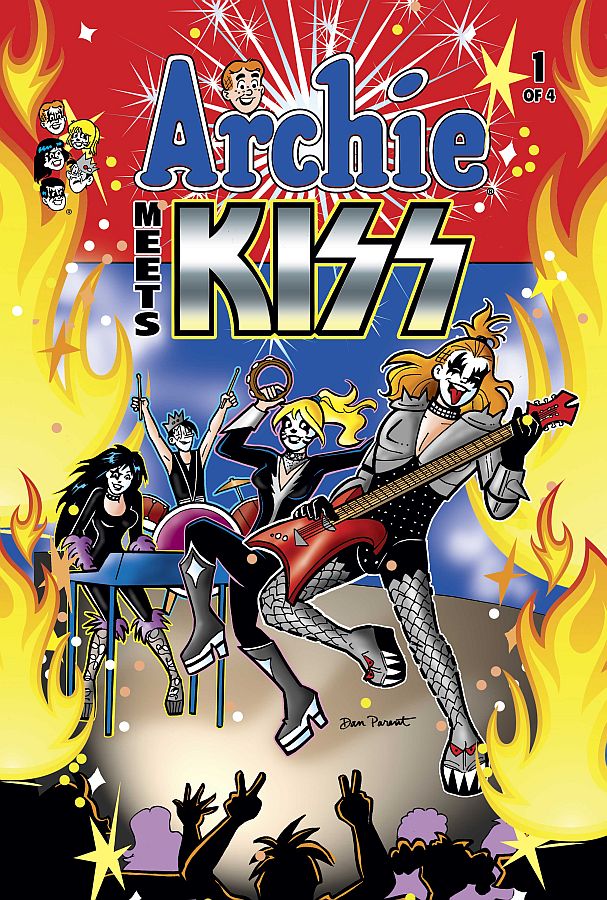
A crossover that is probably more preposterous than the one previously mentioned, but one that I am 100% a fan of already: Archie Meets KISS. Because it's going to be nuts. Oh yeah, and a separate and new KISS series from IDW. Gene Simmons has been busy on the phone setting up these new comics licenses.


Frankenstein: Alive, Alive: IDW has Steve Niles and Bernie Wrightson picking up where the original novel left off. Look at the preview art and tell me this isn't going to be amazing.


Bruce Timm-related news: There was a panel for the new Green Lantern series. This show is definitely on my radar. It's been too long since we had Timmverse TV, and the computer graphics makes me more excited to see how this will turn out. ANNND The Dark Knight Returns will be getting a two-part release in the DC animated movie format. That's something people have been waiting for since the series started!

Brian K. Vaughan is finally back to making comics: Saga from Image. This sounds great, but maybe I'm little bit biased. Can't wait to crack open some new BKV.


There was a Torchwood panel and John Barrowman was wearing a Captain America shirt and announced that he had spent $2,000 on the convention floor before walking into the panel. Then he ended the panel by singing. This probably would have been a highly entertaining way to spend an hour at the con.

Marvel was all about the Avengers movie. There's a trailer now, posters, art, etc. I'll get to it when I get to it.

News from Fantagraphics: They have the license to reprint EC Comics stories now. I like how they aren't doing the same formats that have been tried already. The approach involves volumes dedicated to specific creators. They're also releasing them in black and white, which is a choice I wouldn't expect, but I think it's a good one. Al Williamson sci fi, Wally Wood, Harvey Kurtzman...looks like I'll finally have some EC on the shelf.

And finally, it was SDCC, so of course the Eisner Awards were given out. I did pretty well with my few predictions back in March: Chew took Best Continuing Series, Wednesday Comics got the nod for Best Reprint, and Tiny Titans took the prize for Best Kids' Publication. iZombie wound up losing to American Vampire in the Best New Series category, but at least it was still a win for DC and Vertigo!

Of course there was far, far more that was announced, revealed, teased, etc, but these were some of the things that stood out to me.

Saturday, July 23, 2011

Scarlet Book One


“Revolution!!”
“Rage against the machine.”
“The world is broken and no one will fix it.”

These are all quotes from Brian Michael Bendis’ script for the first issue of Scarlet, which is reprinted as a bonus feature at the end of the collection. The Scarlet Book One Hardcover collects the five comics that reunited Bendis with Alex Maleev for their first major project together since Daredevil. It is far from the typical comic book story, and it’s a kind of yarn that has been all too rare for Bendis since he “hit it big time” and became Marvel’s go-to writer. 

Scarlet Rue is a woman who has been through a lot. She has been victimized by a corrupt society. Sure, there’s plenty of people who have suffered injustice, but hardly anyone is actually able to turn around and say “I’m not going to take this any longer” like she does. Scarlet is going to have to be extreme, and she needs to get results so that she can prove that the world is a place with really huge problems that people seem not to ever notice.

What makes a modern day revolutionary like Scarlet? She once hung around with people in Portland, Oregon who just might have looked like derelicts. They were truly harmless, and Scarlet was in love with one of them, a punkish-looking guy named Gabriel Ocean. A police officer decides to start some trouble, demanding that they empty their pockets because “they must have drugs on them.” Actually, the cop has quite an addiction himself, so anything he finds will be seized for his own private stash. He’s done this kind of thing before. Scarlet and company really don’t have anything and the whole procedure is inappropriate. Gabriel punches the officer...and then a foot chase follows. The end results: Gabriel is shot and killed (and later an online headline falsely proclaims that one of Portland’s “most dangerous drug dealers” has been brought to justice), and Scarlet gets a bullet to the head that doesn’t kill her. She wakes up in the hospital, changed forever. Someone evil has ruined her life and is time for two things now: revenge first, and revolution second. 

Things seem to proceed pretty easily and quickly for Scarlet. She’s making full use of the things that we all use and hear about everyday. A video is posted online of her taking revenge on her boyfriend’s killer, and the following phone conversation between her and the Portland Chief of Police. Enthusiastic supporters participate in a flashmob that gathers hundreds of people in downtown Portland. Scarlet builds herself into a force that cannot be ignored, and Book One promises to show just the beginning of a new kind of revolutionary.


In his introductory notes in his script for Maleev, Bendis remarks that “You’ll also notice that I am using structure and narrative techniques that are anti-cinematic.” This was something that I absolutely loved about Scarlet. It seems like many people tend to think of comics as movies put down on paper. Sure, there is a common visual element, but one has audio and the other has text. And there are plenty of things that can be done in a comic that can’t be accomplished in film. 

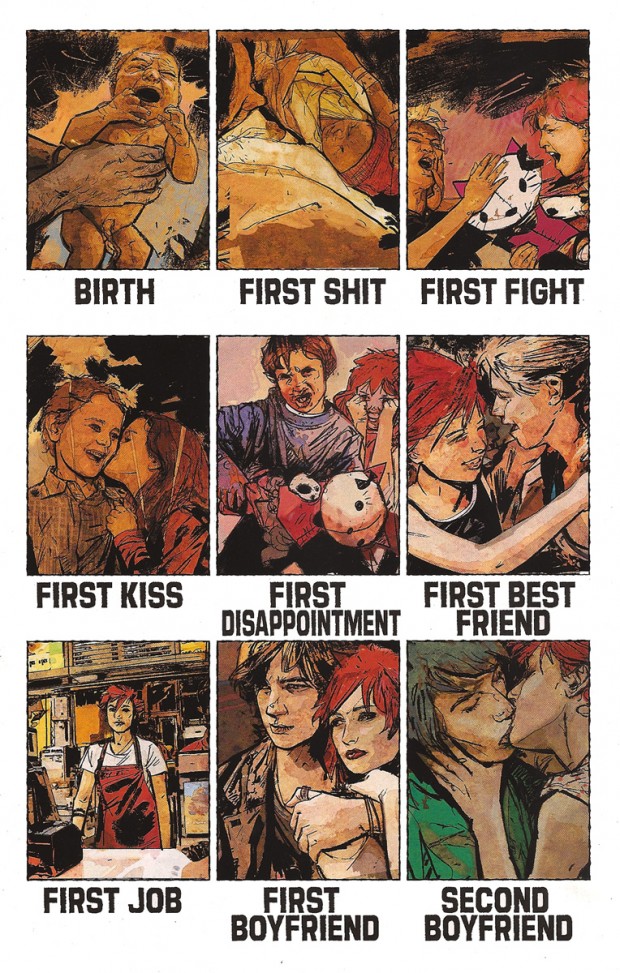
Take for instance the way that Bendis and Maleev give nice and tidy recaps of what happened in a character’s life that brought them to where they are now. Plenty of details of Scarlet’s life are told in just three pages. A simple small image and a caption inform the reader of anything from “birth” (a screaming baby fresh from the womb) to “first job” (a teenaged Scarlet standing behind the counter at some kind of a fast food joint) to “first true love” (a dreamy picture of Gabriel).

Scarlet's backstory, told in a way that only comics can.
Another thing that adds to what makes this comic tick is the narrative style. Scarlet directly addresses the reader, breaking down the fourth wall and carefully explaining herself to anyone who wants to know her story. Scarlet actually isn’t the only character who does this: Detective Going also makes her points clearer by drawing the audience in personally. I’m wondering if when Book Two of Scarlet begins being published we will see more and more characters taking part in this kind of narrative device.


I guess that there are some implausible things that are difficult to ignore in Scarlet. I understand that Bendis loves Portland. But I found it kind of hard to believe that she could successfully remain in hiding in a city like that. She’s killed a police detective, she stands out in a crowd, and she never moves from Portland...it shouldn’t be too hard to find her, right? Scarlet makes me feel like the fictional Portland Police Department is pretty much useless, and I can only hope that their real-life counterparts are a little better at their jobs! 

Also in the “stretching credibility” department: Scarlet survives being shot in the head. Okay, this is fine, I guess. It spurs her on to become the person she never expected to be. And I guess an officer could mess up on a headshot. But by the book’s end Scarlet has survived yet another thing that really should have killed her. Let’s just say that a grenade is used and she somehow mysteriously escapes unharmed. It just seemed unlikely to me, that’s all.

Put those things aside and just sit back with a refreshing indie-feeling comic that just so happens to be put out by two of comics’ biggest stars. Both writer and artist are clearly challenging themselves in Scarlet and pushing themselves to do things in new and different ways. Now we can only hope that moving on to Scarlet Book Two remains a priority for Bendis and Maleev. We’ll see how that pans out...the team is already hard at work on a new Moon Knight series, and personally, I’d rather see more of Scarlet.